Lighting Solutions for Senior Safety: Reduce Fall Risk at Home
Lighting Solutions for Senior Safety: Reduce Fall Risk at Home
Poor lighting is one of the most underestimated fall risk factors in senior homes. The American Academy of Ophthalmology reports that by age 60, most adults need three times more light than they did at age 20 to see the same level of detail. When seniors cannot clearly see floor obstacles, stair edges, and changes in surface height, falls become almost inevitable. Strategic lighting for senior safety and fall prevention is one of the most affordable and impactful home modifications available.
This guide covers the types of lighting that matter most, where to install them, and how to create a comprehensively well-lit home that supports safe aging in place.
Understanding Senior Vision Changes
Before selecting lighting, it helps to understand why seniors need different lighting than younger adults:
- Reduced light sensitivity: Aging eyes let in less light, requiring brighter ambient illumination
- Slower adaptation: Transitioning from bright to dim areas (or vice versa) takes longer. Sudden changes from a well-lit kitchen to a dark hallway create a temporary blindness period
- Increased glare sensitivity: While more light is needed, it must be diffused. Direct, harsh lighting creates painful glare that actually reduces visibility
- Reduced contrast sensitivity: The ability to distinguish between similar tones decreases, making it harder to see edges, steps, and obstacles in monochromatic lighting
- Narrowed visual field: Peripheral vision diminishes, requiring lighting to be more directly in the line of sight
Room-by-Room Lighting Guide
Hallways and Transitions
Hallways are high-risk transition zones where falls frequently occur. Optimal hallway lighting includes continuous illumination with no dark spots between fixtures, motion-activated fixtures that turn on automatically when someone enters the hallway, even brightness levels that match adjacent rooms (no sudden bright-to-dark transitions), and switches at both ends of every hallway.
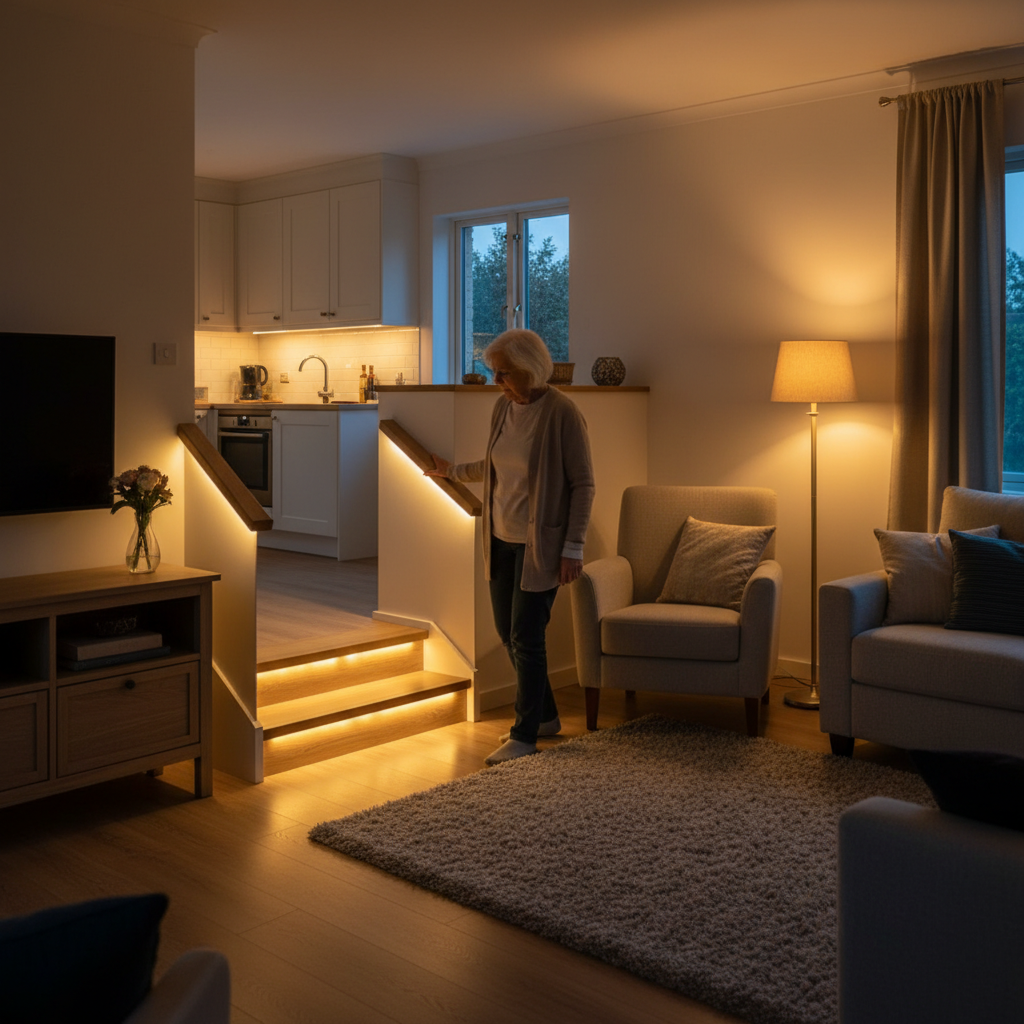
Motion-activated LED strip lights along the base of hallway walls are an excellent solution. They provide low-level illumination that guides nighttime walking without requiring a switch and without producing enough brightness to disrupt sleep.
Stairways
Stairways require the highest-quality lighting in the home. Every stair tread should be clearly visible, and the edge of each step must be distinguishable from the one below it. Install overhead fixtures that illuminate the full stairway without casting shadows on individual treads. Add strip lighting under each stair nose or along the stair stringers for enhanced edge visibility. Ensure light switches are accessible at both the top and bottom. Consider illuminated handrails that combine lighting with physical support.
Bathrooms
Bathrooms need bright, even illumination without glare off wet surfaces. Use vanity lighting at face height to eliminate under-eye shadows that can cause disorientation. Install motion-activated night lights near the floor for nighttime trips that activate without requiring a switch to be found in the dark. Choose fixtures rated for wet locations and avoid exposed bulbs that create glare spots on wet tile.
Bedrooms
Bedroom lighting should support two scenarios: daytime activity and nighttime safety. For daytime, provide adequate ambient lighting for dressing and reading. For nighttime, install motion-activated night lights along the path from bed to door, a bedside touch lamp or switch-accessible light that can be activated without standing, and soft, warm lighting (2700K-3000K color temperature) that does not fully disrupt sleep patterns.
Kitchen
The kitchen requires task lighting for safe food preparation and general ambient lighting. Install under-cabinet lighting to illuminate countertops where cutting and cooking occur. Ensure the stove area is well-lit to see burner controls and pot contents. Provide even overhead lighting that eliminates shadows on the floor where spills might occur.
Best Types of Lighting for Seniors
LED Bulbs
LED bulbs are the best choice for senior homes. They provide instant full brightness (no warm-up time), last 15-25 years reducing the need for bulb changes, produce minimal heat reducing burn risk, are available in a wide range of color temperatures, and use significantly less electricity reducing utility costs.
Choose LED bulbs in the 3000-4000K color temperature range for most rooms. This provides bright, clear light without the harsh blueness of daylight-rated bulbs. For bedrooms and nighttime lighting, use warmer 2700K bulbs.
Motion-Activated Lights
Motion-activated fixtures eliminate the need to find and operate switches in the dark. They are essential for hallways, bathrooms, stairways, and the path from bedroom to bathroom. Battery-operated motion sensors can be added to existing fixtures or installed as standalone units with adhesive mounting.
Smart Bulbs
Voice-activated smart bulbs allow seniors to control lighting without walking to a switch or finding a remote. "Turn on the hallway light" is all it takes. Smart bulbs can also be programmed to gradually increase brightness in the morning and dim in the evening, supporting natural sleep cycles. Many systems can be controlled by family members remotely, allowing caregivers to verify that lights are on at appropriate times.
Common Lighting Mistakes to Avoid
- Relying on floor lamps: Floor lamps are trip hazards due to cords and can be knocked over. Replace with wall-mounted or ceiling fixtures where possible
- Using single, central fixtures: One ceiling light creates shadows around the room's edges. Use multiple light sources for even illumination
- Ignoring exterior lighting: The walkway to the front door and porch area should be well-lit with motion-activated fixtures
- Too-bright bulbs without diffusion: Bare, high-wattage bulbs create painful glare. Use frosted bulbs or fixtures with diffusing shades
- Dark switch plates: Install illuminated switch plates or switches with glowing indicators so they can be found in the dark
Frequently Asked Questions
How many lumens do seniors need in their home?
Seniors typically need 50-100% more lumens than younger adults. As a general guideline, hallways and bedrooms should have at least 300-400 lumens per fixture, bathrooms 500-600 lumens, kitchens 700-800 lumens, and reading areas 400-500 lumens at the reading surface. Use multiple fixtures to achieve these levels without creating single-source glare.
Are night lights safe to leave on all the time?
LED night lights are designed for continuous operation and are safe to leave on permanently. They generate minimal heat and use negligible electricity. For seniors who wake at night, always-on night lights are actually safer than motion-activated ones because there is no delay between movement and illumination.
What color temperature is best for senior safety?
For general visibility and safety, 3000-4000K (neutral white) provides the clearest visibility without excessive glare. For nighttime lighting, 2700K (warm white) is less disruptive to sleep patterns. Avoid bulbs above 5000K (daylight) as they can create harsh glare and cause eye discomfort for seniors with cataracts or other vision conditions.
Conclusion
Lighting improvements are among the most cost-effective fall prevention measures available. Most homes can be comprehensively upgraded for $100-$500, a fraction of the cost of other home modifications. Start with the highest-risk areas: the bedroom-to-bathroom path, stairways, and hallways. Add motion-activated fixtures where possible and replace all bulbs with appropriate LED alternatives. Proper lighting does not just prevent falls; it gives seniors the confidence to move freely throughout their home, which is essential for maintaining the physical activity that prevents further decline.
Written by